What is a funding rate? Who pays and when
Funding is a payment between longs and shorts that keeps a perpetual close to spot. Who pays whom, how often, and how it changes your PnL.
·
6 min read
Contents
A funding rate is a regular payment between longs and shorts on crypto perpetual futures. A perpetual has no expiry date, so nothing forces its price to meet spot. Funding does that job: the side that pushes the price away from spot pays the other side, and the exchange keeps none of it.
Who pays whom: positive vs negative funding
Positive funding: longs pay shorts. The perpetual trades above the index price, so holding a long costs money and a short earns it.
Negative funding: shorts pay longs. The perpetual trades below the index price.
On NeutronX the index is the oracle price that validators agree on every block. The market header says the same in its tooltip: "Positive: longs pay shorts. Negative: shorts pay longs."
How much you pay: an example
Funding is charged on the size of your position, not on your margin. Take a 1,000 USDC position and a rate of 0.01% per 8 hours: you pay 0.10 USDC every 8 hours, 0.30 USDC a day.
With 10× leverage that position needs only 100 USDC of margin. The same 0.30 USDC a day is then 0.3% of your money, ten times more noticeable. NeutronX also shows each rate per year: 0.01% per 8 hours is 10.95% APR.
How funding works on NeutronX
The rate is quoted per 8 hours and charged for the time that actually passed. BTC, ETH, SOL, XRP and LTC pay every 17,280 blocks, about every 4 hours. The other markets pay every 1,800 blocks, about every 25 minutes. So at 0.01% a 1,000 USDC position on BTC pays about 0.05 USDC per payment.
The rate comes from the order book. Every block the chain compares the oracle price with the average price of 5,000 USDC in the book on each side, that is 500 USDC times the 10× maximum leverage. Gaps under half of the market's execution band, 0.25% on BTC and ETH and 0.5% on the rest, count as zero. Over the funding interval the 10% most extreme readings on each side are dropped and the rest is averaged. The full method is in Funding.
The rate is capped at 0.375% per 8 hours on BTC and ETH and 0.75% on the other markets.
When longs and shorts are not equal, the smaller side pays or receives the full rate and the bigger side's rate shrinks to match. With 4M USDC of longs, 1M USDC of shorts and +0.1%, shorts receive 1,000 USDC and longs pay the same 1,000 USDC, only 0.025% of their size.
Why it shows 0.0000% right now. The rate needs at least 5,000 USDC on both sides of the book within the execution band. On 20 November 2026 BTC had about 2,400 USDC on each side, ETH about 1,500 and the other markets less than 1,400. So every market pays 0 for now. Payments still run on schedule, and the rate turns on by itself once the book is deep enough.
What a high funding rate tells you
A high positive rate means longs are crowded: more traders want to be long than short at this price, and they pay to stay in. A deep negative rate means the same for shorts. It tells you who is paying now, not where the price goes next.
Where to see funding on NeutronX
Trading, market header. "Funding / 8h" shows the current rate with its APR, and "Next funding" counts down to the next payment in time and blocks.
Markets → Contract specs. The Funding group lists the interval, how the premium is sampled, the rate cap and the current rate.
Markets → Funding history. Every payment of the market with its block, rate per 8 hours, APR and mark price.
Your own payments. With a wallet connected, the Funding tab under the chart lists what each position paid or received, and Portfolio → Activity has a Funding filter.
Ask Neo. Type "What's the funding on BTC?" and Neo answers with the current rate and the time of the next payment.
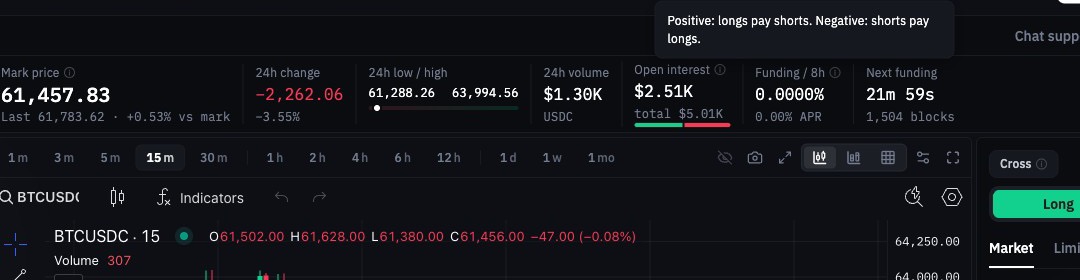
The BTC/USDC header on NeutronX: Funding / 8h with its APR, the Next funding countdown and the tooltip on who pays
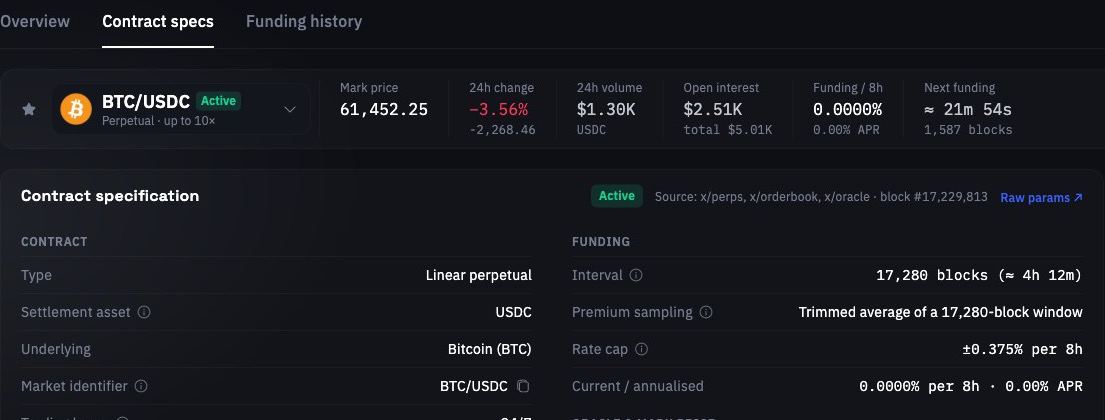
Contract specs of BTC/USDC: a 17,280-block funding interval, a trimmed average premium and a ±0.375% cap per 8 hours
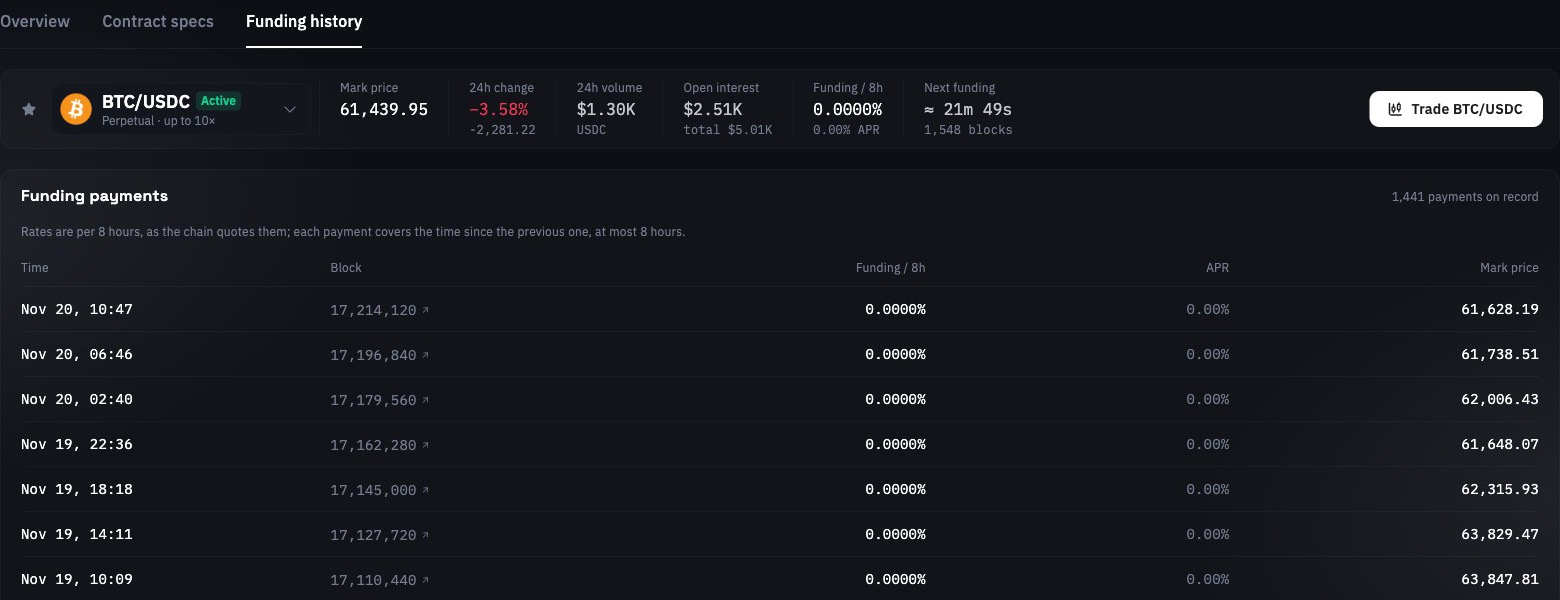
Funding history of BTC/USDC: one payment about every 4 hours with its block, rate, APR and mark price
Tip
A position that is open at the moment of payment pays for the whole interval since the previous one, even if you opened it a minute before. When the rate is high, check the "Next funding" countdown before you open or close.
Good to know
Funding is not an exchange fee. What one side pays, the other side receives.
Only open positions pay or receive it. Orders don't, and closing the position stops it.
It changes your margin. Funding you pay lowers your equity right away, so on a long-held position it can bring liquidation closer.
It is not sent at each payment. It builds up inside the position and moves into your collateral when the position changes or closes.
Spot has no funding. Spot markets settle in the asset itself, without leverage.
Risk
Funding adds up on leveraged positions. At the cap, a 10× long on BTC would pay 3.75% of its margin every 8 hours, more than 11% a day. Keep leverage moderate on positions you plan to hold for days.
FAQ
What is a funding rate in crypto?
It is a payment between longs and shorts on perpetual futures that keeps the perpetual's price close to spot. When the perpetual trades above spot, longs pay shorts; below it, shorts pay longs.
Who pays funding, longs or shorts?
It depends on the sign of the rate. A positive rate means longs pay shorts, a negative one means shorts pay longs. On NeutronX the exchange keeps nothing: the total paid by one side equals the total received by the other.
How often is funding paid?
On NeutronX BTC, ETH, SOL, XRP and LTC pay about every 4 hours (17,280 blocks), the other markets about every 25 minutes (1,800 blocks). The rate is quoted per 8 hours, and each payment covers only the time since the previous one.
Can funding liquidate my position?
Yes, if you pay it for long enough. Paid funding lowers your equity, and with high leverage it can push the position toward its liquidation price. Watch the rate on positions you hold for days.
Try perpetual futures on NeutronX
exchange.neutronx.com/trading