Cross vs isolated margin: which one to use
Cross margin shares your balance across positions, isolated caps risk per trade. See both on a 500 USDC example and pick the right one.
·
6 min read
Contents
With cross margin, all the free collateral in your account backs your positions. With isolated margin, each position risks only the margin you gave it. On crypto perpetual futures that is the whole difference: cross keeps a position alive longer but can lose the whole balance, isolated loses less but is liquidated sooner. If you are new or trade with high leverage, use isolated.
What is margin
Margin is the collateral behind a position. With 100 USDC of margin and 10× leverage you hold a 1,000 USDC position. The margin mode decides which money can be used to cover that position's losses. New to this? Start with Perpetual futures explained for beginners.
Cross margin
On NeutronX cross margin is your main account, subaccount 0. Every position there shares the same collateral.
The position lives longer. Your whole free balance stands behind it, so the price has to move much further before it is liquidated.
One position helps another. Profit on one counts toward the margin of the rest.
The risk is the whole balance. If the subaccount is liquidated, all its positions are closed together, and you can lose everything in it.
The liquidation price depends on all your positions and your free collateral. A small position on a large balance may show no liquidation price at all: the balance would cover a drop to zero.
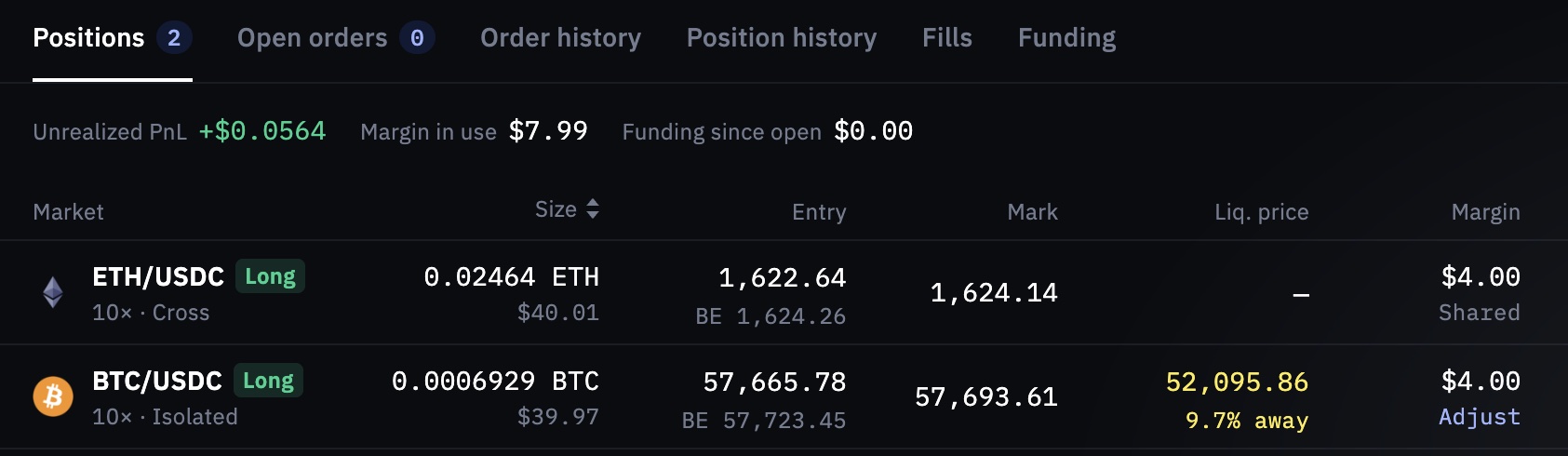
Two 10× longs of about 40 USDC: ETH in cross shows no liquidation price, BTC in isolated is 9.7% from liquidation
Isolated margin
On NeutronX an isolated position opens on a subaccount of its own and holds only the margin you put into it. You can have up to 128 subaccounts.
The loss is capped. At worst you lose that position's margin, and the rest of your balance is untouched.
Liquidation comes sooner. Only the position's own margin protects it, so a 10× long is liquidated after a drop of about 9.5%.
You manage the margin yourself. To move the liquidation price away, you add margin to the position by hand.
One trade in both modes
You have 500 USDC and open a 1,000 USDC long on BTC at 65,000 with 10× leverage, so the margin is 100 USDC. The numbers below ignore fees and funding.
Cross | Isolated | |
|---|---|---|
Collateral behind the position | All 500 USDC | 100 USDC |
Liquidation price | about 32,700, 50% below the entry | about 58,800, 9.5% below the entry |
Lost if liquidated | nearly all 500 USDC | about 100 USDC, the other 400 USDC stay |
Changing the margin | the whole balance already counts | add or remove margin on the position |
In cross the same position survives a fall to about half the price, but it takes the whole account with it if that happens. In isolated it is gone after 9.5%, and you keep 400 USDC.
How much further cross pushes the liquidation price depends on the free balance left after the order. In the screenshot below, an 800 USDC ETH long at 10× leaves only a little balance free, so cross moves the estimate just from 1,467.23 to 1,451.78.
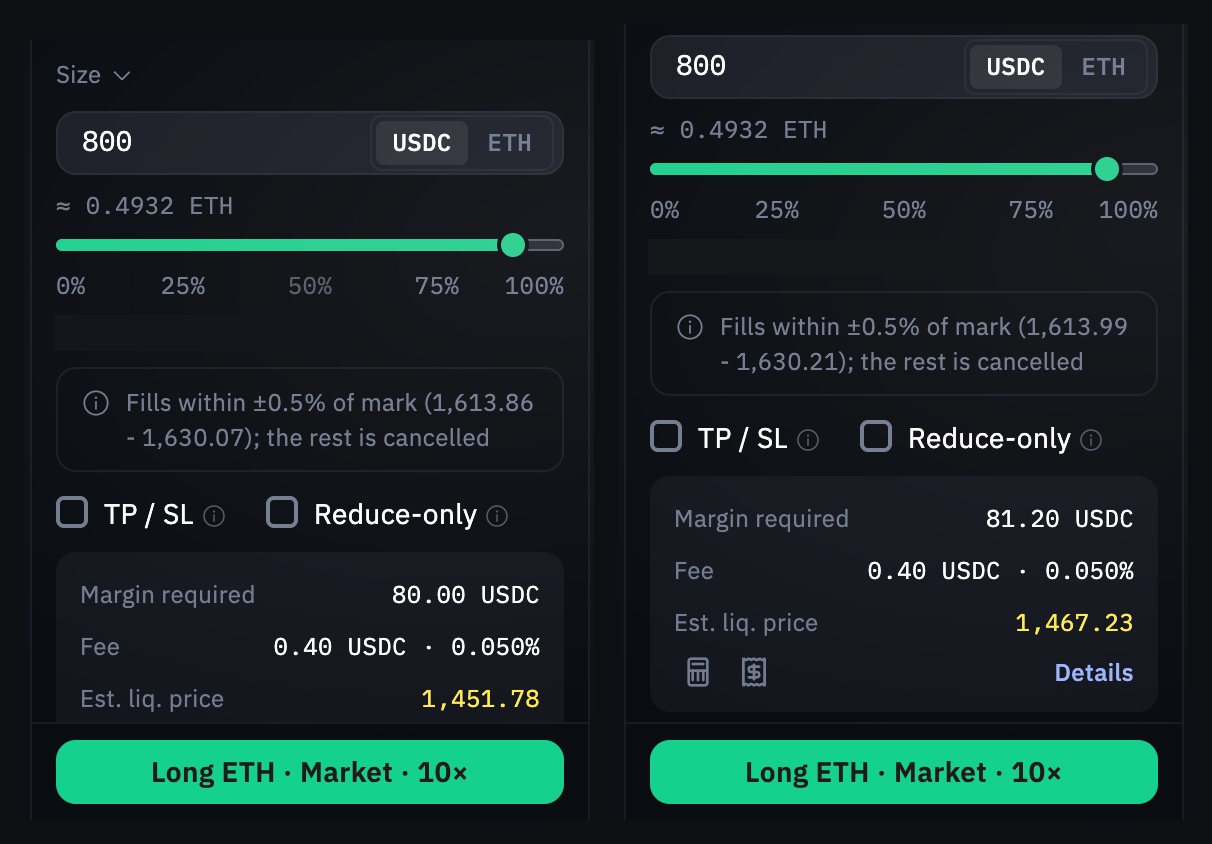
The same 800 USDC ETH long at 10× on NeutronX: est. liq. price 1,451.78 in cross (left) and 1,467.23 in isolated (right)
Cross vs isolated: comparison
Cross | Isolated | |
|---|---|---|
Risk | Your whole balance in the subaccount | Only this position's margin |
Liquidation price | Far, and it moves with your other positions | Close, set by this position alone |
Managing it | Nothing to do, the balance backs it | Add or remove margin by hand |
Suits | Hedges, several related positions, low leverage | Beginners, high leverage, one-off trades |
Which one should you use
Use isolated if you are starting out, if you trade with 5× or more, or if a trade is a bet you can afford to lose. You know your maximum loss before you click.
Use cross for a hedge, for several positions that offset each other, or for low leverage with a balance you are ready to stand behind every position.
How to choose margin mode on NeutronX
Open Trading and pick a market.
Click Cross or Isolated at the top of the order form. A window opens with both modes.
Choose the mode and confirm. It applies to your next orders on this market.
Open the position. Under the market name it says Cross or Isolated, and a cross position shows its margin as Shared.
To add margin to an isolated position, click its margin, open Adjust margin and choose Add margin. The amount moves from your available balance, and the liquidation price moves away. Remove margin works the other way.
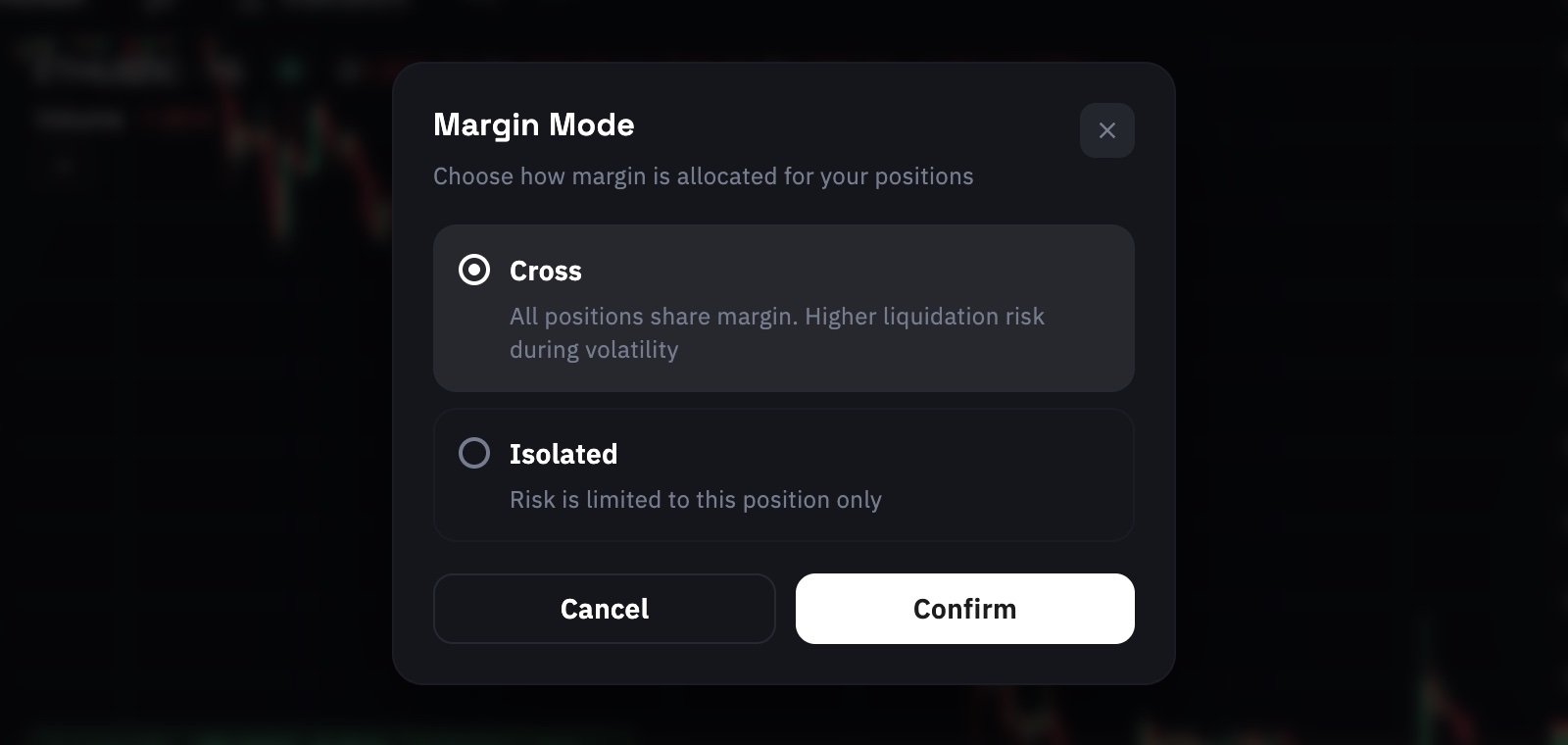
Choosing the margin mode in the NeutronX order form: Cross shares margin across positions, Isolated limits the risk to one position
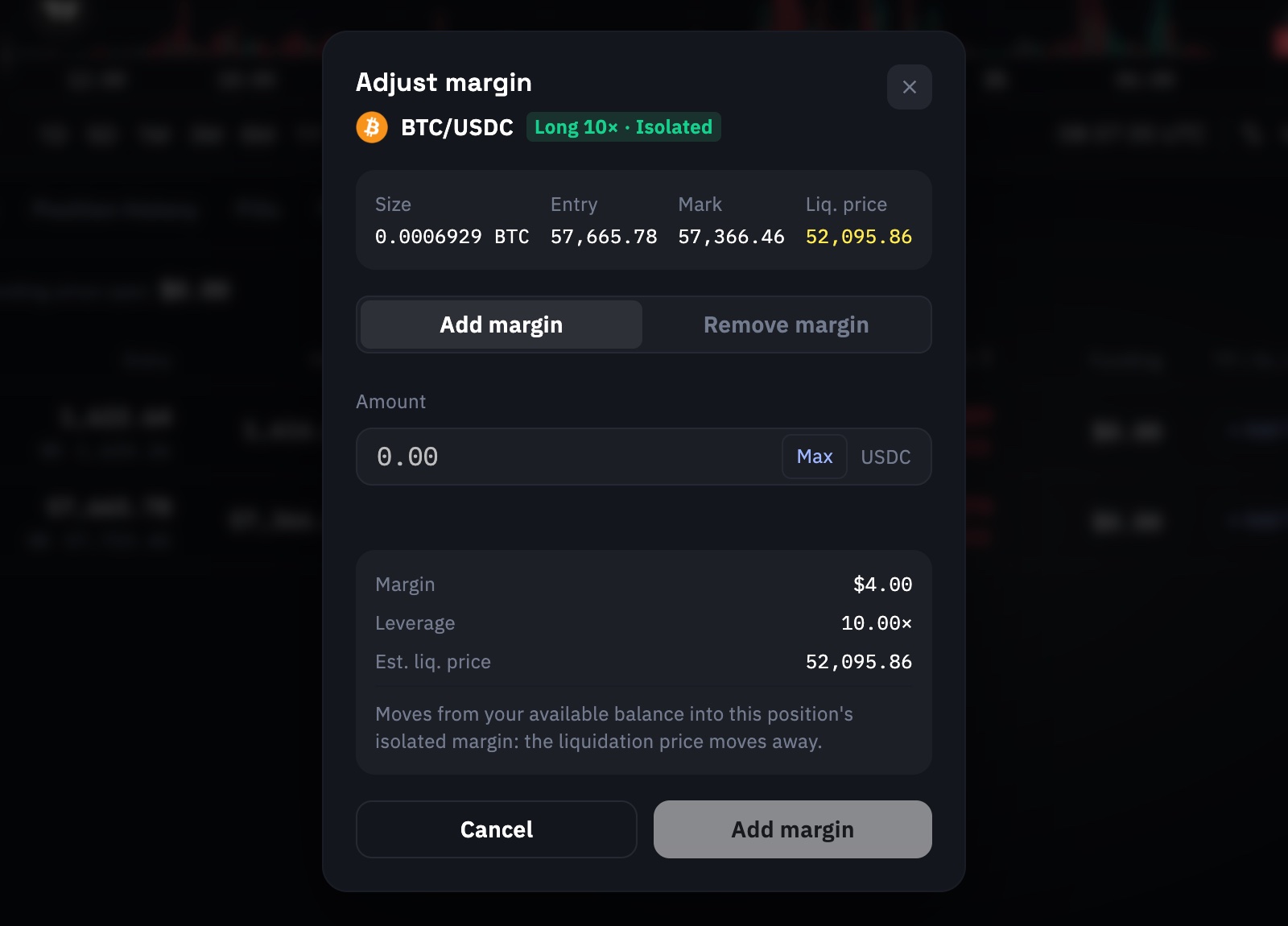
Adjust margin for an isolated BTC position: adding margin moves the liquidation price away
Common mistakes
Cross with high leverage on a single position. It feels safe because the liquidation price is far away, but one bad move can take the whole account.
Forgetting to add margin in isolated. Isolated does not borrow from your balance. If the price moves against you, nothing saves the position unless you add margin yourself.
Not checking the liquidation price after switching modes. The same size and leverage give a very different liquidation price in cross and in isolated.
Good to know
The mode belongs to new orders, not to open positions. An open position stays in the mode it was opened in. To change it, close the position and open it again.
Promo vouchers have no mode switch. A voucher trades from its grant's own subaccount, where positions share its margin.
Hedge mode is always isolated. Each leg gets its own subaccount, margin and liquidation price.
The maintenance margin is the same in both modes: 0.5% on BTC and ETH, 1% on other markets.
Risk
Isolated margin limits a loss, it does not prevent it. At 10× an isolated BTC position is liquidated after a move of about 9.5% against you. In cross the same move is survivable, but a bigger one can empty your account. Read How liquidation works before you trade with leverage.
FAQ
Is isolated margin safer than cross?
It is safer for your balance: the most you can lose is that position's margin. The position itself is liquidated sooner, because nothing else backs it.
Can I switch from cross to isolated with an open position?
No. On NeutronX the mode applies to new orders, and an open position stays where it was opened. To move it, close it and open it again in the other mode.
Does margin mode affect fees or funding?
No. The fee rate depends on your trading volume across all your subaccounts, and funding is charged on the position's size in either mode. Each isolated position simply pays its own funding.
Which margin mode is better for beginners?
Isolated. You know the maximum loss before you open the trade, and one mistake cannot empty your whole account. Combine it with low leverage and a stop-loss.
Try perpetual futures on NeutronX
exchange.neutronx.com/trading