How liquidation works: mark price and ADL
Why positions get liquidated, how mark price and maintenance margin set the trigger, what the penalty and ADL are, and how to avoid it.
·
7 min read
Contents
A liquidation is the forced close of a position when its margin falls to the maintenance margin. On crypto perpetual futures it is triggered by the mark price, not by the last trade, so one large trade or a spike in the order book does not close anyone. On NeutronX the check runs at the end of every block.
New to perps? Start with Perpetual futures explained for beginners.
Mark price vs last price
Price | What it is on NeutronX | What it is used for |
|---|---|---|
Mark price | The oracle price: the stake-weighted median of prices that validators bring from several exchanges, updated every block | Profit and loss, margin, liquidation, stop-loss and take-profit triggers |
Index price | The same oracle price | The reference for funding |
Last price | The last trade in the NeutronX order book | What the order book and the chart show |
On a thin book the last trade can be far from the mark. On 21 November 2026 the last BTC trade on NeutronX was 56,127 while the mark price was 58,163, 3.5% higher. A long with a liquidation price of 57,000 was not liquidated at that moment, because the mark was still above it.
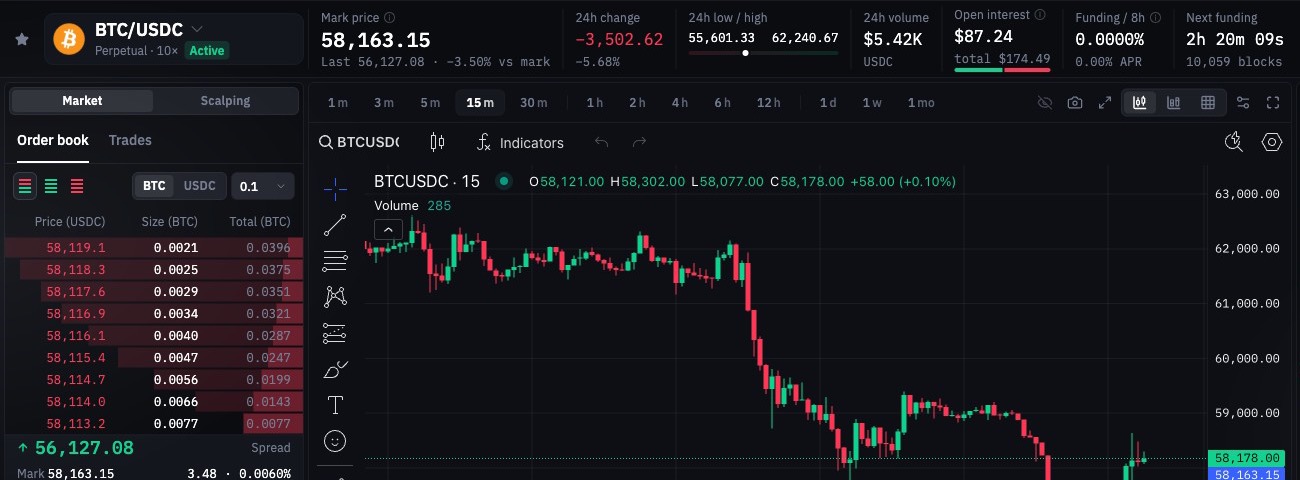
The BTC/USDC header on NeutronX: the mark price above the last trade, 3.5% apart
Initial vs maintenance margin
The initial margin is what you put up to open a position: its size divided by the leverage. With the 10× maximum it is at least 10% of the position.
The maintenance margin is the minimum you must keep: 0.5% of the position on BTC and ETH, 1% on the other markets. The table for every market is in Markets.
Your equity is your collateral plus the unrealized profit or loss of your positions, funding included. A subaccount is liquidated when its equity at the mark price falls to the total maintenance margin of its positions. Before that, NeutronX warns you with a margin call once the maintenance margin takes 80% of your equity.
How to calculate your liquidation price
For a position that stands on its own margin:
Long: entry × (1 − 1 / leverage) ÷ (1 − maintenance margin)
Short: entry × (1 + 1 / leverage) ÷ (1 + maintenance margin)
A 10× long on BTC from 65,000 is liquidated near 58,790, about 9.5% below the entry. A 10× short from the same price is liquidated near 71,140, about 9.4% above it. Fees and funding move these numbers a little.
The price shown on a position is an estimate. The real trigger is the moment your equity reaches the maintenance margin at the mark price. In cross margin it also depends on your other positions and your free collateral. Read more: Cross vs isolated margin.
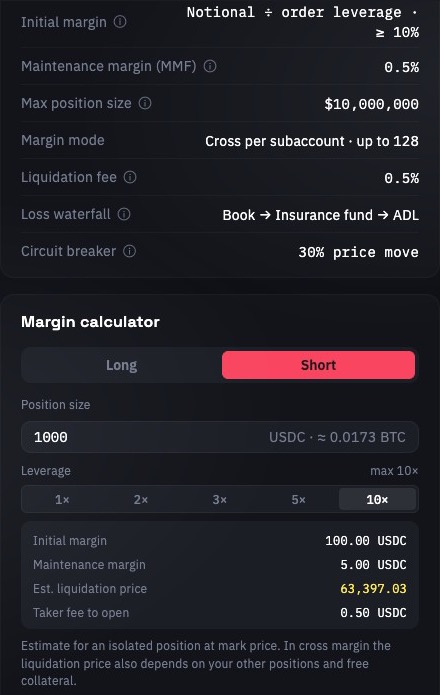
Margin & liquidation for BTC/USDC: 0.5% maintenance margin, a 0.5% liquidation fee and the loss order, with the calculator for a 1,000 USDC short at 10×
What happens during liquidation
At the end of the block the chain finds every subaccount whose equity has reached its maintenance margin. The biggest shortfall goes first, up to 500 subaccounts per block.
It sends a market order to the book to close the positions. You pay no taker fee on it.
Whatever the book cannot take is closed against positions on the other side at the oracle price, without fees. The positions with the highest return on margin go first.
A penalty of 0.5% of the closed size goes to the insurance fund. It never takes your balance below zero.
What is left in the subaccount stays yours.
In cross margin all positions of the subaccount are liquidated together. If the oracle price is stale, liquidation waits for a fresh one. If the market is paused, the whole position is closed against the other side.
A liquidated position stays in Position history, marked Liquidated.
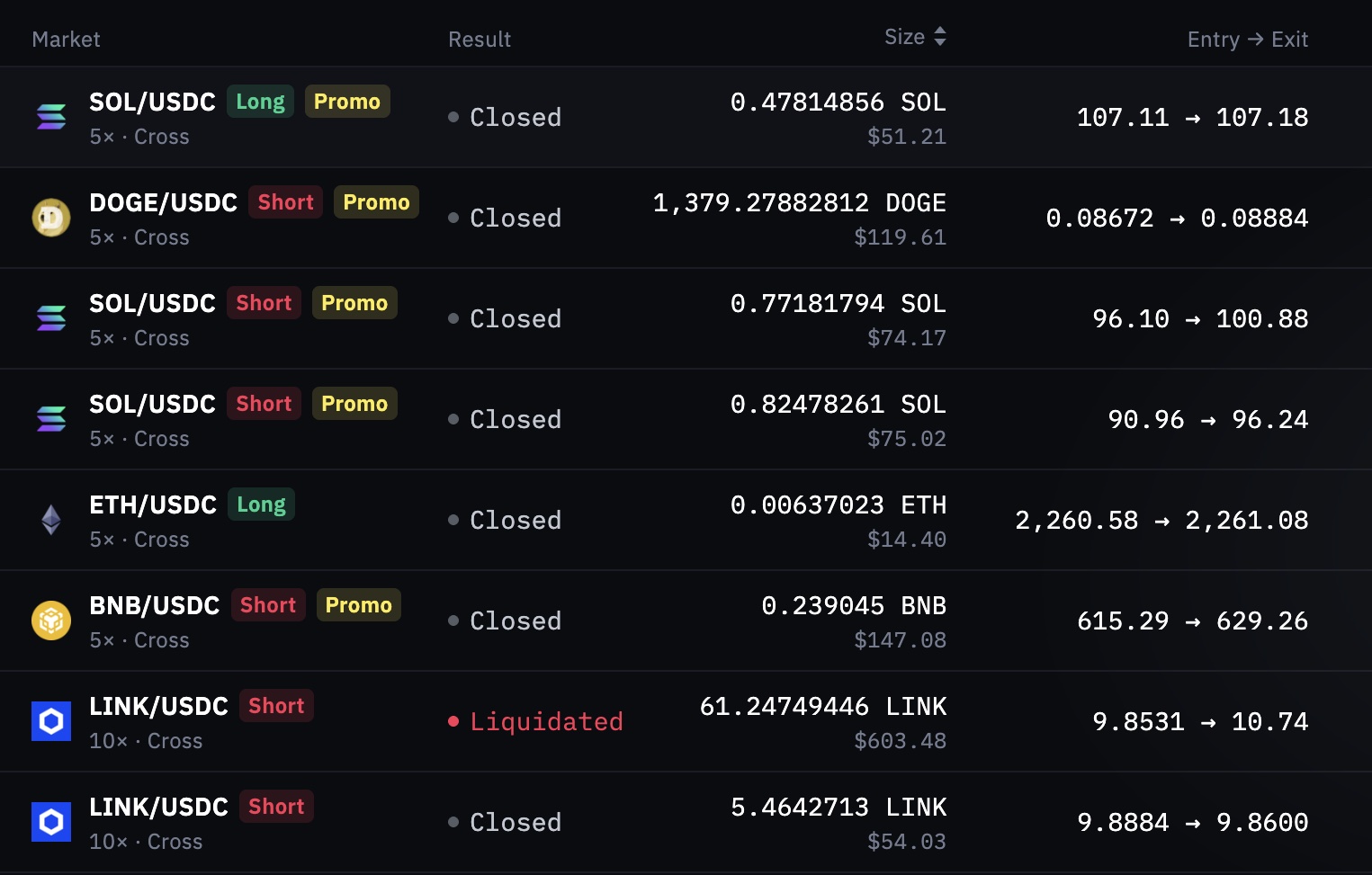
Position history on NeutronX: a 10× LINK short in cross margin marked Liquidated after the price rose from 9.8531 to 10.74
Insurance fund
The insurance fund covers the loss when a liquidated account ends below zero. It is filled by 20% of trading fees, by liquidation penalties and by anyone who sends USDC to it. It pays only for these deficits.
You can see its balance on Markets → Overview, with a link to check the account in the explorer. The network raises a warning when the balance falls below 10,000 USDC and again below 1,000 USDC.
ADL (auto-deleveraging)
ADL is how the other side of the market absorbs a liquidation the book cannot. On NeutronX it happens in two ways.
A forced partial close. When the book cannot take the whole liquidation, the rest is closed against profitable positions on the other side at the oracle price, without fees. If you hold one of them, part of your position closes and you keep the profit on that part. It shows up as ADL in your history.
A share of profit. If the liquidated account is still below zero after that, the insurance fund pays first. If the fund runs out, the profit just made on those forced closes is returned, and then ADL takes profit from the most profitable positions on the other side. They are not closed: their entry price shifts. ADL takes only profit and never turns a winning position into a loss.
Say you hold a profitable 0.5 BTC long while a large short is liquidated, and the book has room for only part of it. The chain may close 0.1 BTC of your long at the oracle price. You keep the profit on that 0.1 BTC, and the other 0.4 BTC stays open.
Anything still uncovered is recorded as bad debt. If it adds up to more than 10,000 USDC, trading stops until governance decides.
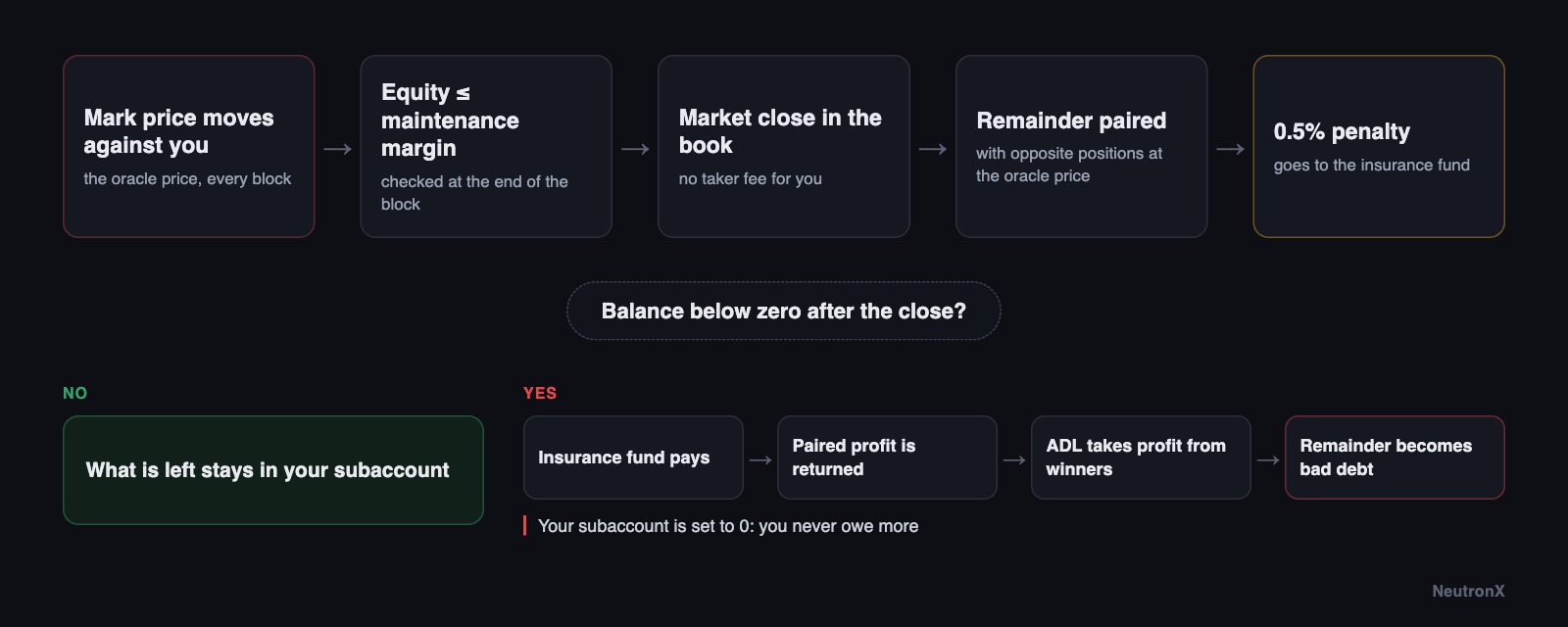
How a liquidation works on NeutronX: the mark price triggers it, the book closes it, the penalty goes to the insurance fund, and a negative balance is covered by the fund, paired profit and ADL
How to avoid liquidation
Use less leverage. At 3× a BTC long has about 33% of room, at 10× only about 9.5%.
Set a stop-loss before your liquidation price. It triggers on the mark price too, so give it some distance.
Use isolated margin for risky trades. A liquidation then takes only that position's margin.
Watch funding on long holds. It is 0% on NeutronX for now, but the cap on BTC is 0.375% every 8 hours. Read more: Funding rate explained.
Add margin early. Act at the margin call warning, not after it.
Use the liquidation map
Other traders' liquidations cluster at certain prices, and price often moves toward those clusters because each liquidation is a forced market order. A liquidation map shows where they sit, so you can keep your own liquidation price and stop-loss away from them.
Risk
Liquidation can take most or all of your margin, and with cross margin it closes every position in the subaccount at once. Use leverage you can afford to be wrong with, and check your liquidation price before every trade.
FAQ
What triggers a liquidation?
Your equity at the mark price falling to the maintenance margin of your positions: 0.5% of their size on BTC and ETH, 1% on other markets. On NeutronX the check runs at the end of every block.
Why was I liquidated if the price never touched my liquidation price?
The chart shows the last trade, but liquidation follows the mark price, which is the validators' oracle price. The two can be several percent apart. The price shown on a position is also an estimate: fees and funding move the real trigger.
What is ADL and can it close my position?
Yes, partly. If a liquidation is too big for the book, the rest is closed against profitable positions on the other side at the oracle price, without fees, and you keep the profit on the closed part. In rarer cases ADL takes some of your profit through an entry price shift instead.
Do I lose my whole margin when liquidated?
Often most of it. Liquidation starts when only the maintenance margin is left, and the 0.5% penalty and slippage take the rest. You can never lose more than the balance of that subaccount.
Try perpetual futures on NeutronX
exchange.neutronx.com/trading