Perpetual futures explained for beginners
What a perpetual future is, how leverage, margin, funding and liquidation work, and how to trade your first perp safely, with real examples.
·
8 min read
Contents
A perpetual future is a contract on the price of a coin that never expires. You can profit when the price goes up or down, trade with leverage and never buy the coin itself. On NeutronX every crypto perpetual futures market is settled in USDC, so your margin, profit and loss are all in dollars.
Perpetual vs spot vs dated futures
Perpetual future | Spot | Dated future | |
|---|---|---|---|
Do you own the coin? | No, only a position on its price | Yes | No |
Leverage | Up to 10× on NeutronX | None | Usually yes |
Expiry date | None | None | A fixed date |
What keeps the price near spot | Funding payments | It is the spot price | Settlement on the expiry date |
A perpetual sits between the other two. Like spot, you can hold it as long as you want. Like a futures contract, it lets you go short and use leverage.
Long and short
A long earns when the price rises, a short earns when it falls. Open a 1,000 USDC long on BTC, and a 2% rise gives you +20 USDC; a 2% drop costs you 20 USDC. A 1,000 USDC short works the other way round: +20 USDC on the drop, −20 USDC on the rise.
You never deliver or receive BTC. When you close, only the difference in price is settled in USDC.
Leverage and margin
Margin is the collateral you put behind a position. With 100 USDC of margin and 10× leverage you control a 1,000 USDC position. NeutronX allows up to 10× on every market, and the initial margin is the position size divided by the leverage you choose.
To keep the position open, you need the maintenance margin: 0.5% of the position on BTC and ETH, 1% on the other markets. Leverage multiplies your profit and your loss by the same amount. Read more: Cross vs isolated margin.
Mark price
Your profit, loss and liquidation are counted at the mark price, not at the last trade. On NeutronX the mark price is the oracle price: validators bring prices from several exchanges, and the chain takes the stake-weighted median every block.
The two can differ a lot on a thin book. On 21 November 2026 the last BTC trade on NeutronX was 56,127 while the mark price was 58,163, 3.5% higher. A single large trade does not liquidate anyone. Read more: How liquidation works.
Funding
A perpetual has no expiry date, so funding keeps its price close to spot: when the perpetual trades above the index, longs pay shorts, and below it, shorts pay longs. The rate is quoted per 8 hours, and BTC, ETH, SOL, XRP and LTC pay about every 4 hours. On NeutronX the rate is 0% on every market for now, because the book is not yet deep enough. Read more: Funding rate explained.
Liquidation
If losses eat your margin down to the maintenance level, the position is closed by force. A 10× long on BTC from 65,000 is liquidated near 58,800, about 9.5% below the entry. A penalty of 0.5% of the closed size goes to the insurance fund. Read more: How liquidation works and How to read a liquidation map.
Order types
Market: fills right away at the best prices in the book, within a band around the mark price (±0.5% on BTC).
Limit: waits in the book at your price.
Stop-loss and take-profit: close the position when the mark price reaches your trigger.
TWAP: splits a large order into equal parts over a set time.
POV: trades a set share of the market's volume, from 1% to 30%.
Read more: TWAP orders and POV orders.
Fees
A maker order, one that waits in the book, pays 0.02%. A taker order, one that fills against the book, pays 0.05%. A 1,000 USDC market order therefore costs 0.50 USDC. The rates go down with your trading volume, to 0% for makers and 0.025% for takers. The full table is in Fees.
A full trade, with numbers
Say you have 200 USDC and open a 3× long on BTC at 58,000. The position is worth 600 USDC, about 0.0103 BTC, and the taker fee to open it is 0.30 USDC. Its liquidation price is near 38,860, about 33% below the entry.
BTC rises 5%, to 60,900. The position earns about 30 USDC. You close it with a market order and pay about 0.32 USDC in fees, so you keep about +29.40 USDC.
BTC falls 5%, to 55,100. The position loses about 30 USDC, and with both fees you are down about 30.60 USDC. The position is still far from liquidation.
Funding would add or take a little on every payment while the position is open. Right now it is 0 on every NeutronX market.
Why trade perps on a DEX
Your funds stay under your key. Balances, positions and orders live on the chain, and you withdraw with an ordinary transaction that nobody has to approve.
Matching happens in consensus. The block proposer matches orders, and every other validator repeats the matching and rejects the block if the result differs.
Nobody gets priority. Market makers have no privileges: orders at the same price are ranked by their block and their place in it.
Everything is checkable. Every trade, liquidation and fee is an event in a block that anyone can read.
There are limits too. After a large bankruptcy, withdrawals and transfers pause for a set number of blocks, and transfers to other networks go through a channel with a shared limit.
Your first trade: 5 rules
Start with low leverage, 2× or 3×. At 3× a long is liquidated after a drop of about 33%, at 10× after about 9.5%.
Set a stop-loss right away. It triggers on the mark price, so keep it above your liquidation price.
Don't put all your margin into one position. Isolated margin limits the loss to that position.
Check the liquidation price before you confirm. The order form shows it, and the margin calculator in the contract specs does too.
Look at the funding rate if you plan to hold the position for days.
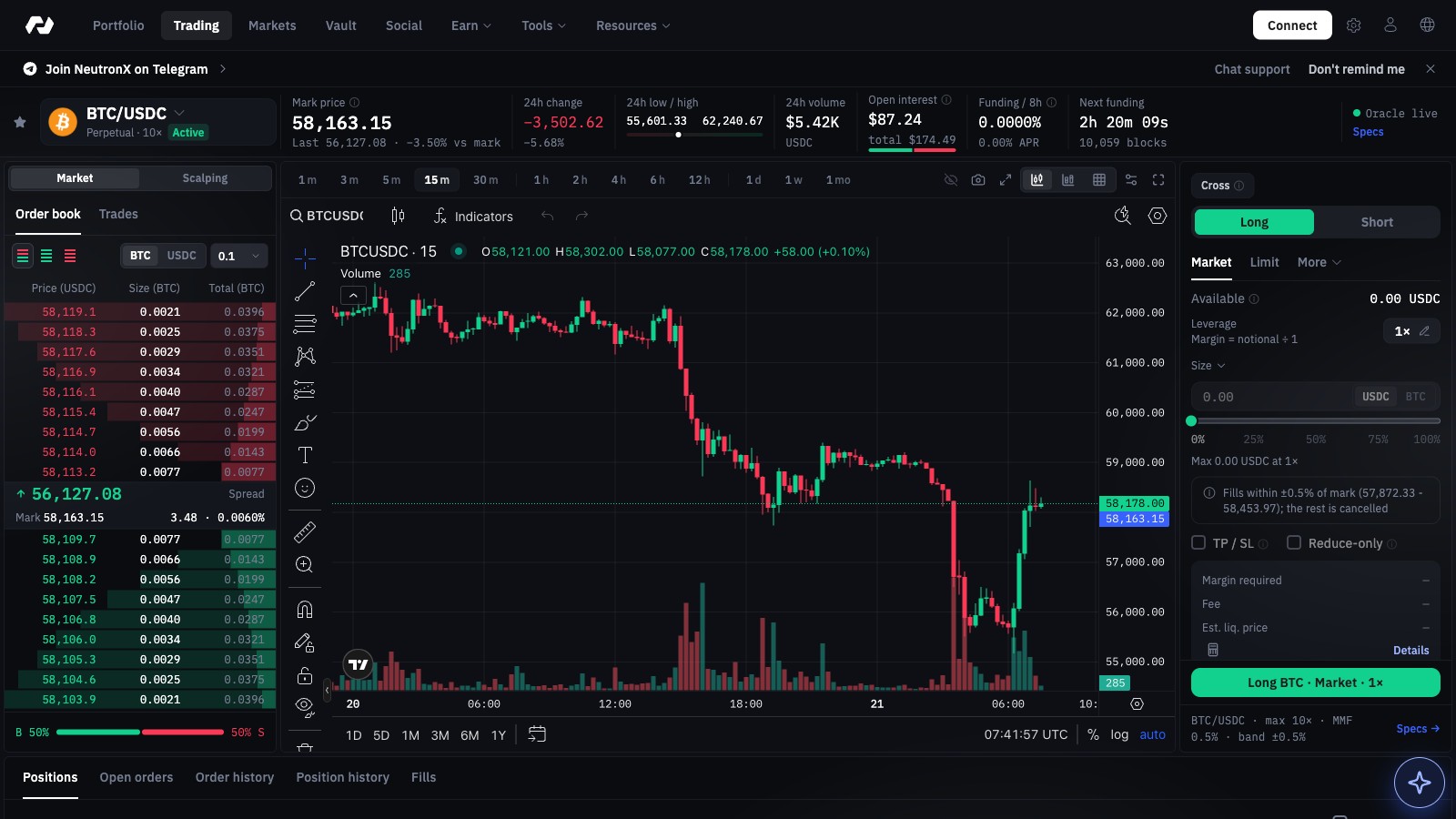
The NeutronX trading screen for BTC/USDC: mark price, last trade, funding and the order form
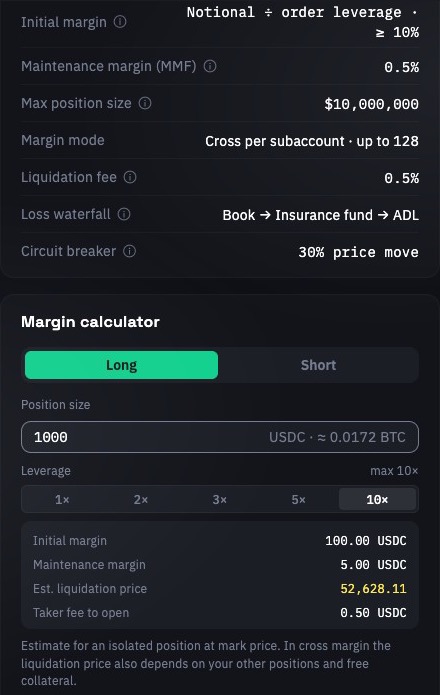
The margin calculator: a 1,000 USDC long at 10× needs 100 USDC of initial margin, with an estimated liquidation price
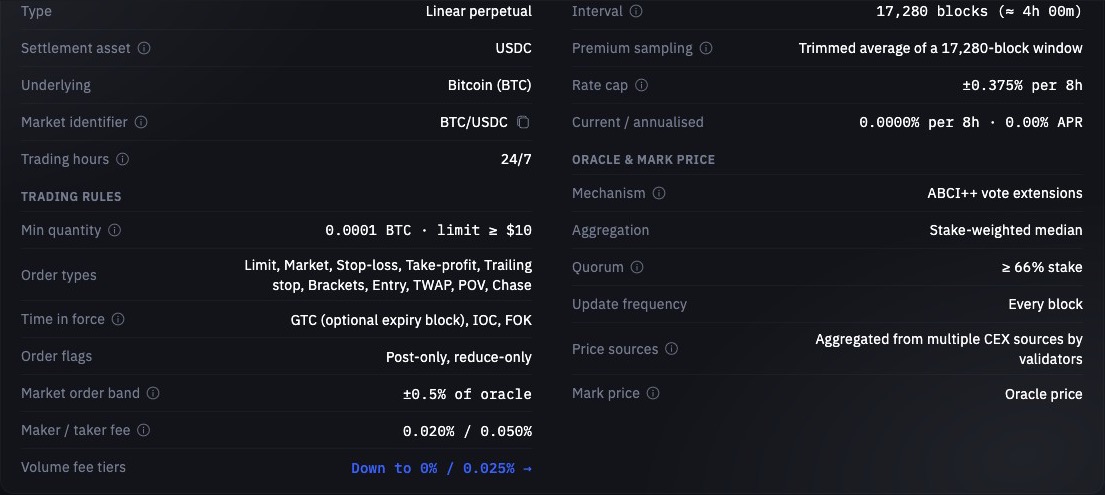
BTC/USDC contract specs: order types, maker and taker fees, the market order band and the oracle that sets the mark price
Tip
Before your first real trade, put your size and leverage into the margin calculator on Markets → Contract specs. It shows the margin, the maintenance margin, the liquidation price and the fee without connecting a wallet.
Good to know
There is no expiry, but there is funding. Holding a position for weeks is possible, and funding is what it costs or pays.
Profit and loss follow the mark price. The last trade in the book can be several percent away from it.
Leverage changes the risk, not the fee. Fees are charged on the full position size, not on your margin.
Each market has its own minimum. On BTC the smallest order is 0.0001 BTC, and a limit order has to be worth at least 10 USDC.
Markets never close. They trade 24/7, and a single BTC position can be as large as 10,000,000 USDC.
Risk
Perpetual futures with leverage can lose your whole margin quickly. At 10×, a 9.5% move against you is enough to liquidate a BTC position. Start small, use a stop-loss and never trade with money you cannot afford to lose.
FAQ
What are perpetual futures in crypto?
They are contracts on a coin's price with no expiry date. You can go long or short with leverage and never own the coin; on NeutronX they settle in USDC, and funding keeps their price close to spot.
How are perpetual futures different from spot?
On spot you buy the coin itself and can only profit when it rises. A perpetual is only a position on the price: you can short it, use up to 10× leverage on NeutronX, and you pay or receive funding while it is open.
Can you lose more than you deposit on perpetual futures?
Not on NeutronX. If a liquidation leaves your subaccount below zero, the chain sets it back to zero, and the gap is covered by the insurance fund and, if needed, by the profitable side through ADL. You can still lose everything that is in that subaccount.
What leverage should a beginner use?
2× or 3×. At 3× a long on BTC is liquidated only after a drop of about 33%, which leaves room for mistakes; at 10× the same position is gone after about 9.5%.
Try perpetual futures on NeutronX
exchange.neutronx.com/trading